Introduction
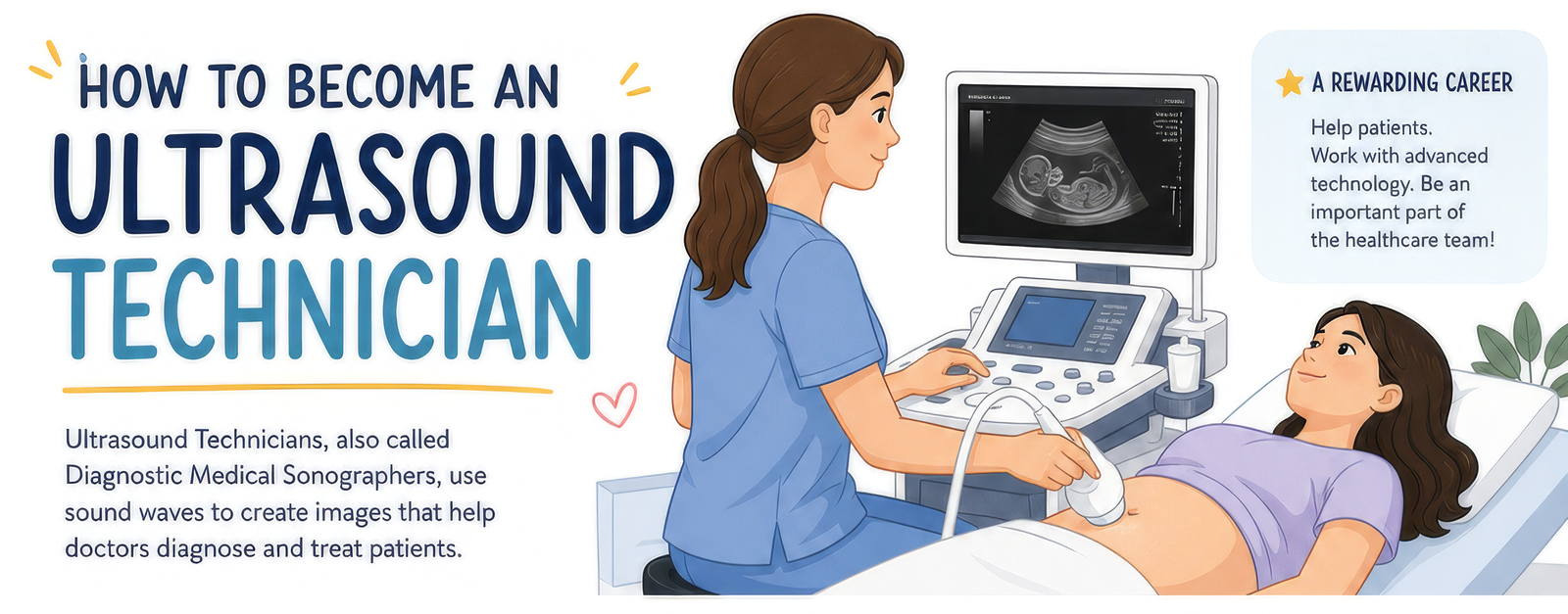
How to become an ultrasound technician is one of the most searched healthcare careers. For many people who are seeking a healthcare career that pays better, has a steady demand and is quicker to pursue than medical school. In addition, ultrasound technicians, also known as diagnostic medical sonographers, moreover play an essential role in diagnosing disease by producing high-quality ultrasound images without exposing patients to radiations.
Moreover, a career is popular due to the combination of patient care, technology, medical knowledge and job security. as a result, a career for many people, who can enter the field with an associate’s degree or postsecondary certificate.
This guide explains how to become an ultrasound technician, including educational requirements, clinical training, essential skills and career opportunities.
Why become an ultrasound technician?
Ultrasound is a widely used, non-invasive and cost-effective imaging technique which is gaining in popularity. As a result, demand for sonographers continuously increases.
1. Strong Salary Potential
With the right qualifications and experience, ultrasound technicians can find competitive wages. However, salary may vary depending on location, working environment, experience, certification and speciality.
2. This career path can be completed in less time than a lot of healthcare positions.
Furthermore, it is not necessary to gain a 4-year medical degree and become a doctor to pursue a career in sonography. Instead, a large number of students start with an associate degree that generally takes about 2 years to complete.
3. Multiple Career Specialities: Furthermore, these specialities allow a sonographer to choose a speciality according to their interest.some of them are following :
- Abdomen sonography
- Obstetrics and gynecology
- Breast sonography
- Vascular technology
- Cardiac sonography
- Paediatric sonography
- MSK sonography
Therefore, you have lot of options after becoming ultrasound technician
What pathway is needed?
Moreover, if you are interested in healthcare and don’t want to spend many years in medical schools, becoming an ultrasound technician can be an excellent career option…so understanding how to become an ultrasound technician is more important than just choosing a degree.
1- Complete high school or earn a GED!
Additionally, high school and/or a GED are the first steps to becoming an ultrasound technician.
Certificate:
Therefore, many accredited sonography certificate programmes will accept a high school diploma or GED. The Commission on Accreditation of Allied Health Education Programs (CAAHEP) has a searchable database of certificate programmes and other accredited training for allied health professionals, including ultrasound technicians.
Meanwhile, while you are in high school, make a good foundation in anatomy and physics to become competitive ultrasound technician
2: Choose the Right Education Path for sonography
Typically, a diagnostic medical sonography programme of study is required for the pursuit of an ultrasound technician career.
Typically, there are three usual ways of education:
Program Type | Typical Duration | Best For
Associate Degree: 18–24 months Most entry-level students
Bachelor’s Degree: 4 years, Students interested in advanced career or management opportunities
| Certificate Program | 12–18 months | Current healthcare workers or people with prior medical education |
Ultimately, choosing the right pathway prepares you for a successful career.
3: Look for a CAAHEP-Accredited Program
Additionally, going through a CAAHEP-accredited diagnostic medical sonography programme means that the certification process is smoother, as it is recognised and established based on the accepted standards of professional education.
Before enrolling, consider the following questions:
- What will my degree/certificate be?
- How many clinical hours are there?
- What percent of people pass the ARDMS exam?
Therefore, cross-checks will help you to become the best ultrasound technician.
4-complete Clinical training
Clinical training is where you gain real-world experience. So that’s why you will work under supervision in hospitals, clinics, or imaging centres.
For example, during clinical rotations, you may observe and perform scans such as the following:
- Abdominal ultrasound
- Pelvic ultrasound
- Obstetric ultrasound
- Vascular ultrasound
- Small parts ultrasound
- Breast ultrasound
In addition, during clinical training, you’ll get to know how to interact with patients, adhere to scan time requirements, stick to protocols and capture diagnostic-quality images.
5: Prepare for ARDMS certification.
Finally, one of the largest steps towards becoming a competitive ultrasound technician is certification.
- ARDMS is the most popular credentialing body and has the following credentials:
- RDMS: Registered Diagnostic Medical Sonographer
- RVT: Registered Vascular Technologist
- RMSKS: Registered Musculoskeletal Sonographer
Skills Needed to Become a Successful Ultrasound Technician
Moreover, skills required to become a successful ultrasound technician are the following:
Some of them Important skills include:
Technical Skills
The knowledge of operating ultrasound equipment, adjusting image settings, recognising anatomy and capturing a high-quality image all have to be known.
Attention to Detail
Little variations in the images may be significant. It’s important that sonographers adhere to the protocol very carefully and that they are very aware of the subtle findings.
Communication Skills
Patients can be anxious, uneasy or in pain. When you explain all the processes wisely, then the patient must be satisfied.
Frequently asked questions (FAQS):
Is an ultrasound technician a radiologist?
No. A radiologist is a medical doctor who decodes imaging tests. An ultrasound technologist conducts the ultrasound scan and records the images for physicians to view.
Is it possible to get into the ultrasound tech job without going to school?
There may be certificate programmes available, particularly for those who have experience in healthcare. But many entry-level students will earn an associate degree in diagnostic medical sonography.
How difficult is it to become an ultrasound tech?
It can be difficult to attend ultrasound technician school due to the anatomy, physics, patient care and hands-on skills involved in scanning.


Great article! The information is well-organized and easy to understand. Thank you for sharing such valuable guidance.